Hunting for Beginners

Although the air was clear and sunny, I managed to catch a faceful of what our hunting guide laughingly called “Georgia snow”. A state worker from New Jersey had just shot the head off a bobwhite quail, and I was downwind of the ensuing spray of white feathers. My phone, raised above eye level to try to get a photo of the hunter and her prey, wasn’t nearly big enough to shield me from the flurry. I swiped the feathers off my face and followed our small hunting party as they walked into the brush to retrieve the newly headless bird. The New Jerseyite placed it into the pocket of her blaze orange vest, where it joined two other quails she’d already downed with a shotgun. The other student in our hunting party, a woman from Oklahoma, had shot one bird so far. I was a student just like them, but today I’d chosen to shoot only pictures.
We were walking the woods of a plantation near Social Circle, Georgia, as newly certified and licensed hunters. This guided bird hunt was a sort of practicum based on our previous two-and-a-half days of intensive study and field exercises. A total of eighteen government workers from around the nation had gathered in a classroom to learn about why, what, and how people hunt game animals in this country. The curriculum was geared toward adult students with no hunting experience, which was the vast majority of us. Many of us had never even held a loaded weapon; I had spent one day shooting guns in the forest with a friend, years ago, and didn’t care for it.
The other commonality we shared was a career at a public agency focused on natural resource conservation: anything from back-office IT support (like me) to wildlife biology to finance to communication. Even if we don’t personally interact with hunters on the job, they are key stakeholders in the missions that we theoretically support in our everyday work. So, our respective agencies had sent us to this workshop to learn more about the methods and motivations of our hunting constituency.
There was no stated intent to recruit us into the sport—only to educate—but deep down I thought I could become a convert. I already enjoy being outdoors, and hunters and fishers make a big deal about how their sport gives them an excuse to be outside. I’m more familiar with what they call non-consumptive uses of nature: hiking, biking, beachgoing, watching animals without harvesting them. I learned from our panel of instructors, who had many decades of hunting experience, that they sometimes go on a “hunt” with no intention of shooting anything. They go for peace and quiet, to enjoy a hike through the wilderness, or for camaraderie with friends and family. It reminded me of the bike camping trips I used to take with friends. Similar to hunting, those outings required specialized gear, except we carried that gear on bikes instead of on our backs. We would haul our stuff under pedal power for miles until reaching a campsite—then we’d unpack our food and booze, build a fire, and spend the night reveling. We all loved riding bikes, but the experience was less about the act of cycling than it was about the freedom of being outside while enjoying each other’s company. I understand the appeal of that for a hunter.
I also understand the desire to feel closer to nature by developing a deeper knowledge of animals, even if that insight is ultimately used to kill some of them. (It’s worth noting that regulated hunting plays an important role in population control for several species; humans are not even close to wiping out deer, elk, cougars, bears, of waterfowl through hunting.) Most of our instructors at the workshop were trained biologists as well as hunters, and it was clear that they respected the game animals they pursued. They taught us a range of things that hunters need to know about their quarry: morphology, at a bare minimum, to ensure you’re chasing a member of the correct species and only harvesting the age and sex of animal allowed by law. Knowing the critter’s habits and being able to recognize their footprints helps you track them in the wild. Having a grasp on their anatomy helps you get a cleaner kill shot.
We pretended to be trackers in a wooded preserve, scanning for drops of blood and broken branches left in the wake of a mortally wounded animal heading for its final resting place. Our instructors had planted dollops of fake blood in various shades of red, and quizzed us on which part of the body each color was likely to have seeped from. At the end of this phony trail, we found a limp deer hide that represented our dead prey. We asked questions about what would be done with the animal’s guts in a real scenario. (Answer: To make the animal easier to pack out, gut it in the field and leave the entrails to decompose or be eaten. Alternatively, take the whole animal to a meat processor and let someone else do the dirty work for a price.)
In a more lighthearted exercise, we took turns testing our ability to be sneaky while tracking live prey through the forest. One person, the prey, was blindfolded and stood still in the middle of the rest of us predators. The predators took turns approaching the prey, one step at a time, trying our best not to make noise in the leaves and twigs. If they prey detected us, we were out. I began to appreciate the sense of intrigue involved in hunting. Everyone grinned when it was their turn to silently approach the “prey animal”. Maybe that’s because we were adults excited to be given the chance to play a childlike game, or maybe it’s because people of all ages enjoy the thrill of the chase. We all relish the feeling of watching somebody without being noticed. (Invisibility was one of the superpowers I most wished for as a kid.) I could imagine spending a day following an animal through the woods, observing its behavior, savoring the temporary disconnection from industrialized life. It was harder to imagine myself firing a gun or sharp-tipped arrow at one of that animal’s vital organs.
We had a lot of instruction and hands-on practice with firearms, which made up a large component of the Hunter Education exam we were required to pass to get our Georgia hunting licenses. I learned about rifles, shotguns, and muzzleloaders, and how to measure the size of ammunition going into each one. I learned how to load ammo into guns with lever, bolt, break, pump, and semi-automatic action. In a darkened classroom, I mounted an unloaded shotgun and used it to follow a laser pointer along the wall, at roughly the height of a bird’s flight, and said “bang!” when I thought I had shot it.
We practiced getting into shotgun stance many times, using guns with varying degrees of realness, in preparation for shooting clay pigeons and, ultimately, quail.
By the time we got to the shooting range, I hadn’t decided if I wanted to participate in the quail hunt. It wasn’t mandatory, although everybody was required to tag along with or without a gun. Theoretically I was interested; it would be a new experience, possibly very exciting, potentially revealing an underlying skill or desire I’d never known about. I was very curious to see how I’d do with target shooting. It had been probably 15 years since that day I’d gone shooting with a friend in Oregon, when my discomfort was palpable. (“She’s from California,” I overheard my friend telling his buddy, as if that explained my timidity.) I reasoned, dubiously, that maybe I’d be more confident handling a firearm now that I was older and more self-assured.
We broke into smaller groups and cycled through different stations at the range. Tin birds and cardboard squirrels were propped up for us to hit with tiny pellets launched from air rifles. I managed to clip a couple of metallic bird wings with my weapon, but the squirrels remained unharmed. At the adjacent station, I found my inner Ralphie Parker and learned how to load and shoot a Red Ryder BB gun. Five of us students lined up in front of a tarp festooned with a string of soda cans and shot at them, over and over again, tilting the BB guns down and then up to reload each time. I mostly missed. Although I wasn’t finding an inner talent for marksmanship, I actually had fun firing those lightweight guns.
The shotgun range was next. As much as I was trying to be brave, I’d been dreading it all day. Each of us got paired with a mentor inside a little three-sided wooden structure, which was open more or less from the waist up, allowing us to position the shotgun barrel outside and sweep it from side to side within a safe zone of fire. I donned foam earplugs, and had a beanie stretched over my ears. I was afraid of the noise and hoped the hat would offer extra protection; also, it was cold in January. My mentor started by reviewing shotgun stance again, then she launched a couple of clay birds for me to follow with an unloaded gun, so I could get used to the motion. I said “Pull!” and she stepped on a trigger to release the clay, which was a bright orange disc flying downrange, like a bird trying to escape into the bushes beyond the grassy field. I tracked it with the end of my muzzle, imagined shooting it, followed through, then pointed the gun back down.
I signaled that I was ready for live ammo. My mentor loaded two 20-gauge shells, one for each barrel in the shotgun. I got into a ready stance and said “Pull!” The clay took off, and I brought the gun stock up to my cheek while switching the safety off in one (relatively) smooth motion, like they’d taught us. I pulled the trigger, and holy shit, the explosiveness was startling. My right earplug had come loose as I’d cocked my head, so the boom was louder than I’d expected. I felt a little panicked at the sheer power of the weapon in my hands. I took a moment to breathe and fix my earplug, then told my mentor to pull again, eager to get this over with. I hadn’t hit my target the first time. With the second shot, I hit the edge of the clay bird, but didn’t feel gratified. I was breathing rapidly and on the verge of panicky tears.
I told my mentor that I didn’t want to shoot anymore. She said that was fine, of course, but she didn’t really know what to do with me as I sat on a bench and let tears fill my eyes. I felt like such a dud. Everyone else was loving the shotgun shooting. Right in front of me, an administrator from the Georgia Parks Department was blasting clay after clay, and she jumped up and down with glee. My mentor, having no mentoring to do, started walking around and cleaning up shell casings. After our time at the shotgun station ended, another student noticed my trouble and tried to ask what it was that I’d struggled with. I generalized it as “too noisy,” not really in the mood to explain myself. Inside, I was regressing to all the times in childhood when I’d felt I didn’t fit in with others.
It was clear that I would be a photographer, not a shooter, on the next day’s quail hunt. I felt relieved that I’d never have to handle a firearm again, but apprehensive about being so close to live ones. We set out as a party of eight: two hunters, a mentor for each, one photographer, one guide, and the guide’s two eager hunting dogs. The dogs would travel ahead of and around us, under orders to find where the birds were hiding, trotting through tall grasses and brambles without a care. When a dog would stop and point—forming a motionless arrow from nose to tail—the guide would gesture for us to get closer and for the hunters to get ready, because the dog had sniffed out some birds there. Then he’d use a cane to flush the quail from their resting place. That’s when I would typically raise my hands to try to cover my ears, while either the New Jersey biologist or the Oklahoma GIS analyst took their shot at the birds. My sensitivity to noise did not make me a good action photographer, but I got many pictures of our group walking among beautiful scenery.
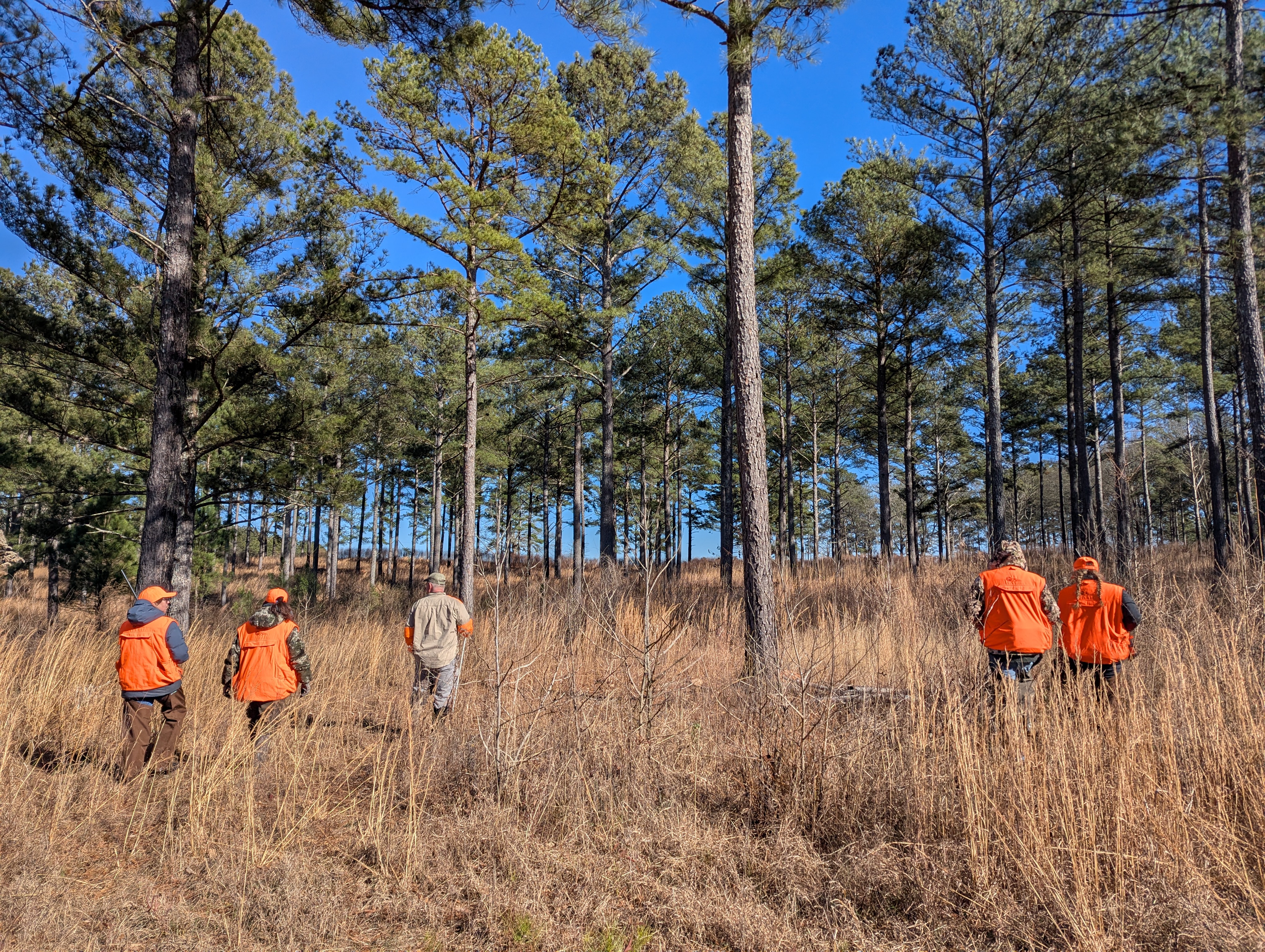
I enjoyed the experience as a day hike, but also, surprisingly, shared the thrill of the hunt as an observer. Everybody was joyful, and a collective sense of pride swelled whenever one our party shot a bird. We also recognized that this was a hunting opportunity for which regular customers pay hundreds of dollars apiece; we were lucky enough to be out here as part our jobs, getting a respite from desk work. I ended the day with no particular distaste for hunting, even after observing (and helping, a little) the process of cleaning the dead birds back at camp. I have nothing but respect for the hunter who leaves no trace, harvests their kill ethically, and utilizes the animal for food, hide, or fur. It’s not a pastime for me, but I might be willing to join a friend on a hunt someday.
Our workshop participants harvested almost 50 quail that day, and brought the frozen birds home with them to cook. I brought home a scratchy throat that evolved into bacterial pneumonia. Damn Georgia snow.